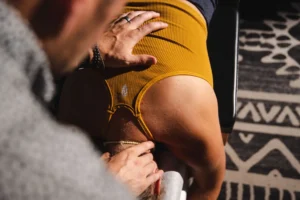

Piriformis syndrome and sciatica produce very similar symptoms, pain that spreads from the buttock down the leg, but they start in different places. True sciatica usually comes from a nerve root irritated in the lower back, often by a disc. Piriformis syndrome happens when a tight piriformis muscle deep in the buttock irritates the sciatic nerve further down its path. Treating one when you actually have the other is a common reason people with buttock and leg pain stay stuck, so getting the distinction right is where effective care begins.
What Is Piriformis Syndrome?
The piriformis is a small, deep muscle in the buttock that runs from the sacrum, the triangular bone at the base of the spine, to the top of the thighbone. It helps rotate and stabilize the hip. The sciatic nerve usually runs just underneath it, and in about one in six people it passes partly through the muscle.
Piriformis syndrome happens when the piriformis becomes tight, irritated, or goes into spasm and irritates the sciatic nerve beneath it. The result is pain, tingling, or numbness in the buttock, hip, and down the back of the leg. It’s hard to tell apart from sciatica that starts in the lower back, because the same nerve is involved.
It’s worth knowing that piriformis syndrome is somewhat debated. It’s a real condition, but it can be both overdiagnosed and missed, which is why a careful exam matters.
What Is True Sciatica?
True sciatica means irritation of a nerve root in the lower back, most often from a herniated or bulging disc, or from spinal stenosis narrowing the space the nerve travels through. Learn more in our posts on herniated discs and bulging vs. herniated disks.
Because the irritation begins in the spine, true sciatica often comes with lower back pain alongside the leg symptoms, though not always. Some people mainly feel it in the leg, which adds to the confusion.
How to Tell the Difference
There’s no single test that settles it in every case, but several patterns give strong clues.
Where the Pain Is Strongest
Piriformis syndrome usually feels most intense deep in the buttock, often at one tender spot. Lumbar sciatica more often involves the lower back, with leg pain following the nerve down from there, and it’s more likely to travel below the knee.
What Makes It Worse
Piriformis syndrome is often aggravated by sitting for long periods, especially on hard surfaces, and by movements that rotate or stretch the hip, like climbing stairs or walking uphill. Lumbar sciatica is often aggravated by bending forward, long sitting, coughing, and sneezing.
Exam Tests
A straight leg raise, lifting the leg while lying flat, often reproduces lumbar sciatica symptoms because it tensions the nerve root. It’s less consistent with piriformis syndrome. Pressing on the piriformis, or stretching it in a figure-four position, is more likely to reproduce piriformis symptoms.
Imaging
Many people with piriformis syndrome have normal lumbar MRIs, because the irritation is in the buttock, not the spine. And many people have disc findings on imaging that don’t cause any symptoms. That’s why a clinical exam matters more than imaging alone.
Don’t Forget the SI Joint
The sacroiliac joint, where the spine meets the pelvis, can also cause buttock pain that spreads into the thigh. It sits close to the piriformis, and the two often act up together, so a good exam checks both.
Why Misdiagnosis Is So Common
A patient with deep buttock pain and leg symptoms gets an MRI that shows a mild disc bulge, and the bulge becomes the assumed culprit, even if the main irritation is at the piriformis. Treatment then focuses on the disc, the patient doesn’t improve as expected, and no one revisits the diagnosis.
In my practice, I’ve seen Lancaster patients who were treated for lumbar sciatica for months without much change, and who improved once we recognized the piriformis was involved. The lesson isn’t that lumbar problems don’t matter. It’s that a careful assessment matters more than matching symptoms to the most common diagnosis.
When to Get Medical Care Right Away
Go to the emergency room right away for loss of bladder or bowel control, numbness in the groin or inner thighs, or leg weakness that’s getting worse quickly. See a doctor promptly for a foot that drags or slaps when you walk, or buttock and leg pain with fever, unexplained weight loss, or a history of cancer.
What Drives Piriformis Tightness
Prolonged Sitting
Hours of sitting keep the hips in one position and put direct pressure on the buttock, which can irritate the piriformis and the nerve beneath it.
Hip and Pelvic Imbalances
Uneven hip rotation or weak glute muscles can make the piriformis work harder on one side, which is why piriformis syndrome often affects only one side.
Stress and Muscle Guarding
Like all muscles, the piriformis responds to the nervous system. When your body is stuck in a stress response, the muscles of the hips and lower back tend to stay tight, which can add to piriformis tension. That’s one reason stretching alone sometimes brings only short-term relief.
What You Can Do at Home
- Break up long sitting by standing and moving every 30 to 45 minutes.
- Avoid sitting on a wallet or phone in your back pocket.
- Try a gentle figure-four stretch, and stop if it sharpens your leg pain.
- Strengthen your glutes and hips with exercises like bridges and side-lying leg raises.
How We Approach Piriformis Syndrome at Life Potential Chiropractic
Network spinal care helps the nervous system release the held tension that keeps the hips and lower back guarded. Using light, specific touches along the spine, it helps your body shift out of defense mode, which many patients find helps the piriformis and surrounding muscles relax. Every person is different, and results vary.
We start every new patient with a Stress Response Evaluation, using heart rate variability and brainwave analysis, to see how much stress your nervous system is carrying. We also take a thorough history and exam to check whether the lower back is involved alongside the piriformis, since both can be present, and the care plan needs to address the full picture.
Frequently Asked Questions
Can I have both piriformis syndrome and lumbar sciatica at the same time?
Yes. A disc problem can irritate the nerve in the lower back while the piriformis irritates it further down. When both are present, addressing only one tends to bring incomplete relief, which is why a thorough assessment matters.
Will stretching the piriformis fix the problem?
Stretching can bring real relief. If tension keeps coming back, strengthening the hips and addressing the stress and guarding behind the tightness tend to make the improvement last longer.
How long does piriformis syndrome take to resolve?
Recent cases often improve within a few weeks of the right care. Long-standing cases take longer, but meaningful improvement is often possible with a consistent plan. Our post on acute vs. chronic pain explains why.
If you’re dealing with buttock and leg pain in Lancaster that hasn’t responded fully to treatment, call Life Potential Chiropractic at (717) 847-6498 or schedule your $29 Discovery Session to get a thorough assessment and find out what’s driving your symptoms.