
Scoliosis doesn’t have to mean a lifetime of worsening pain or an inevitable path to surgery. Gentle, nervous system-focused care can help manage scoliosis symptoms, improve posture, and give the spine a better environment to stay as stable as possible – without forcing or manipulating a curve that may not be reversible. The goal is to work with your spine, not fight against it.
What Scoliosis Actually Is
Scoliosis is an abnormal lateral curvature of the spine – meaning the spine curves sideways instead of running in a straight vertical line. When viewed from behind, a scoliotic spine might look like an S or a C rather than a straight column.
It’s more common than most people realize. Mild scoliosis affects somewhere between 2-3% of the population, and many cases are never formally diagnosed because symptoms are minimal. More significant curves can cause visible postural changes, chronic back pain, and over time, reduced mobility and breathing difficulties if the curve progresses and affects the rib cage.
Most scoliosis is classified as idiopathic, meaning the cause isn’t clearly known. Adolescent idiopathic scoliosis – which develops during the growth spurts of early adolescence – is the most common form. But scoliosis can also develop in adults due to degenerative changes in the spine, or as a result of neuromuscular conditions.
The Conventional Approach to Scoliosis
For mild curves (generally under 20 degrees), the standard medical recommendation is watchful waiting – monitoring the curve over time to see if it progresses. For moderate curves in adolescents who are still growing, bracing is often recommended to try to prevent further progression. For severe curves, surgery – typically spinal fusion – becomes part of the conversation.
For most adults with scoliosis, the approach is usually pain management: physical therapy, anti-inflammatories, and in more significant cases, surgery. What’s often missing is any real focus on the nervous system’s role in how scoliosis affects the body – and what can be done at that level.
How the Nervous System Connects to Scoliosis
Here’s something that rarely comes up in a standard orthopedic consultation: your nervous system has a significant influence on muscle tone along the spine. The muscles on either side of the vertebrae are constantly being regulated by neural signals. When those signals are balanced, the muscles support the spine evenly. When the nervous system is under chronic stress or has developed compensatory patterns, that muscle balance can be disrupted.
In scoliosis, this imbalance is often very visible – one side of the back tends to be more prominent, and the muscles on that side are working harder than the other. Addressing the nervous system patterns that contribute to this imbalance doesn’t straighten the curve, but it can reduce the muscular tension that’s pulling on the spine, ease pain, and improve the spine’s overall environment.
This is especially relevant for adults with scoliosis. Unlike adolescents, adult spines are done growing – the structural curve isn’t going to change dramatically in either direction. But the pain and limitation that comes with scoliosis often has as much to do with the muscle tension, nerve irritation, and postural compensation around the curve as it does with the curve itself.
What Network Spinal Care Offers for Scoliosis
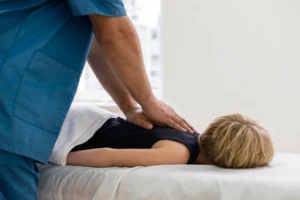
Network spinal care is fundamentally different from traditional chiropractic adjustment. There’s no forceful manipulation of the spine, no cracking or twisting. Instead, light, specific touches are made along the spine in a way that helps the nervous system recognize and release stored tension.
For someone with scoliosis, this matters for several reasons.
First, it’s safe. Because the approach is gentle and works with the nervous system rather than against the spine’s structure, it doesn’t force the spine into positions that could be harmful or that ignore the reality of the curve. This is important – scoliosis patients should be cautious about any approach that involves aggressive manipulation of a curved spine.
Second, it addresses something that most other treatments don’t: the tension patterns the nervous system has developed around the curve. When the nervous system holds chronic tension in the muscles along a scoliotic spine, that tension becomes its own source of pain and limitation – separate from the curve itself. Releasing it through network spinal care often brings meaningful relief.
Third, it helps the body find better postural strategies. As the nervous system learns to hold less tension and operate from a place of greater ease, people often notice shifts in how they carry themselves – less hunching, less compensating, less of the protective guarding that comes with chronic pain.

What to Realistically Expect
I want to be direct here, because honesty matters more than a compelling pitch. Network spinal care is not going to straighten a scoliotic curve. For structural scoliosis that has been present for years, the curve is what it is. What we can do is help the nervous system and the musculature around that curve function as well as possible – reducing pain, improving mobility, and giving the spine the best possible environment to stay stable.
For patients in Lancaster who come to us with scoliosis, the most common outcomes we see are reduced pain, improved posture, better overall movement, and a significant improvement in quality of life. That might sound modest compared to the promise of “fixing” a curve, but for someone who’s been living with daily scoliosis-related pain, those changes are life-changing.
The Assessment Process
Before starting any care at Life Potential Chiropractic, we conduct a comprehensive Stress Response Evaluation. This two-part assessment uses Heart Rate Variability (HRV) analysis and brainwave analysis to get a clear picture of how your nervous system is functioning – how much tension it’s holding, how well it’s adapting to stress, and where the imbalances are most significant.
For someone with scoliosis, this gives us important information beyond what an X-ray shows. It helps us understand how much the nervous system is contributing to your symptoms and how to design a care plan that actually addresses the root of what you’re experiencing.
Care plans are personalized based on what the assessment reveals, and typically run 3-9 months. We track your progress and adjust as the nervous system responds.
Living with Scoliosis in Lancaster
Scoliosis often develops quietly and gets diagnosed in adolescence, but its effects can follow people for decades. By the time many adults seek care, they’ve been managing scoliosis-related discomfort for years – often told that there’s not much to be done beyond monitoring and pain management.
That’s a frustrating place to be. And while it’s true that we can’t reverse a structural curve, the idea that nothing can meaningfully improve your quality of life with scoliosis isn’t accurate. The nervous system is adaptable. The body is resilient. And with the right approach, there’s often a lot of room to feel better than you do right now.
At Life Potential Chiropractic, we work with patients throughout Lancaster County who are looking for a gentler, more thoughtful approach to managing scoliosis. We’re not promising to fix a curve that took years to develop. We’re offering a real, personalized plan to help your nervous system and your spine work together as well as they possibly can.
Frequently Asked Questions
Q: Can network spinal care straighten a scoliotic curve?
A: No – and any provider who claims they can straighten a structural scoliotic curve with manual care should be approached with caution. What network spinal care can do is help reduce the muscle tension, nerve irritation, and postural compensation around the curve – which often significantly reduces pain and improves mobility and quality of life.
Q: Is it safe to receive chiropractic care if I have scoliosis?
A: With the right approach, yes. Network spinal care is particularly well-suited to scoliosis because it uses very gentle touches rather than forceful manipulation. We assess each patient individually before recommending care, and we design plans that are appropriate for the specific curve and the person’s overall health picture.
Q: What’s the difference between scoliosis care for adolescents vs. adults?
A: In adolescents, the spine is still growing, so there’s potential to influence how the curve progresses. In adults, the structural curve is generally stable, and the focus shifts entirely to pain management, maintaining mobility, and supporting the best possible nervous system function. Both groups can benefit from nervous system-focused care, but the goals and expectations differ.
If you’re dealing with scoliosis in Lancaster and want to explore a gentler, nervous system-focused approach, call us at (717) 847-6498 or schedule your $29 Discovery Session to get a full picture of your nervous system health and what we can do to help.