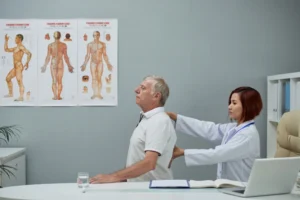

A degenerative disc disease diagnosis can feel like a life sentence – the beginning of a slow decline toward more pain, less movement, and eventually surgery. But for most people, that’s not what the condition has to mean. With the right approach, it’s entirely possible to live well with degenerative disc disease, manage pain naturally, and maintain the function and quality of life you’re not willing to give up.
What Degenerative Disc Disease Actually Means
First, some honest context about the diagnosis itself. “Degenerative disc disease” sounds alarming, but the word “disease” is somewhat misleading – it’s not a disease in the traditional sense. It’s a term that describes age-related changes in the intervertebral discs, the cushion-like structures that sit between the vertebrae of the spine.
Over time, these discs naturally lose some of their water content, become less flexible, and may develop small tears or cracks in the outer layer. This process happens in virtually everyone to some degree – it’s a normal part of aging. The question isn’t whether your discs show some degeneration, but whether that degeneration is producing symptoms and limiting your life.
For some people, significant disc degeneration shows up on imaging but causes minimal symptoms. For others, even moderate changes produce significant pain and stiffness. That difference – and it’s a large one – has a great deal to do with factors beyond the disc itself, including how the nervous system is processing and responding to what’s happening in the spine.
The Nervous System’s Role in DDD Symptoms
This is the part of the picture that most people with degenerative disc disease never hear about: the severity of your symptoms is not determined solely by what’s on your MRI.
When the nervous system is under chronic stress – running in fight-or-flight mode – it amplifies pain signals. Structures that would produce manageable discomfort in a calm, adaptable nervous system produce significantly more pain in a stressed, defensive one. Inflammation, which is heavily regulated by the nervous system, stays elevated. Muscles along the spine stay tense, adding compressive load to discs that are already under pressure.
This is why two people with similar imaging findings can have dramatically different pain experiences. And it’s why addressing the nervous system is one of the most meaningful things you can do for degenerative disc disease – not because it reverses the structural changes, but because it changes how the body relates to those changes.
What Living Well with DDD Actually Looks Like
In my practice, I’ve worked with patients in Lancaster who came in convinced that their DDD meant inevitable decline. Some had been told they’d need surgery eventually. Some had been managing with daily pain medication for years. Some had simply stopped doing the things they loved because they expected movement to make things worse.
What they discovered, through nervous system-focused care, is that their body had more capacity than they’d been led to believe. Not because anything structural had changed – but because the nervous system driving their pain experience had.
Living well with degenerative disc disease generally involves a few things working together: keeping the nervous system as adaptable and regulated as possible, maintaining movement and strength in the muscles that support the spine, managing inflammation through both nervous system care and lifestyle, and staying honest about what the body needs – including when to push and when to rest.
How Network Spinal Care Approaches DDD
Network spinal care is particularly well-suited to degenerative disc disease because of what it doesn’t do as much as what it does. It doesn’t involve forceful manipulation of a spine that may already have compromised disc integrity. There’s no cracking, no twisting, no high-velocity adjustment that puts additional load on structures that are already under stress.
What it does instead is use light, specific touches along the spine to help the nervous system release stored tension and develop new healing strategies. As the nervous system shifts from a defensive, high-tension state into a state of greater ease, several things tend to happen for DDD patients.
The muscles along the spine – which have often been chronically contracted in an attempt to stabilize a painful area – begin to release. That release reduces the compressive load on the affected discs. Inflammation decreases as the nervous system’s anti-inflammatory pathways become more active. Pain signals become less amplified as the nervous system’s threat response dials down. And people start moving again – more freely, more confidently – which itself becomes part of the recovery.
The Assessment Process at Life Potential Chiropractic
Before starting any care, we conduct a Stress Response Evaluation using Heart Rate Variability (HRV) analysis and brainwave analysis. For DDD patients, this gives us critical information beyond what imaging provides – it tells us how much the nervous system is contributing to the pain experience and how adaptable the system is to begin with.
Low HRV – which we find very consistently in people with chronic pain – tells us the nervous system is stuck in a sustained stress state and that its capacity for recovery is diminished. Brainwave analysis reveals the deeper stored stress patterns that often underlie chronic pain far more than the structural findings alone would suggest.
This assessment becomes the basis for a personalized care plan – typically 3-9 months – with regular check-ins to track how the nervous system is responding and adjust the approach as needed.
What We’re Honest About
Degenerative disc disease involves real structural changes that conservative care doesn’t reverse. We’re not going to tell you that network spinal care will restore your discs to their original condition – it won’t, and anyone who says otherwise isn’t being straight with you.
What we will tell you, based on years of working with DDD patients in Lancaster, is that the relationship between structural findings and pain experience is far more variable than most people are led to believe – and that the nervous system is a powerful lever in that relationship. For many patients, shifting the nervous system is what finally makes daily life manageable and meaningful again.
We’re also honest about when surgery needs to be part of the conversation. If DDD has progressed to the point of significant nerve compression with neurological deficits – weakness, loss of bladder or bowel function, rapid progression – those situations require appropriate medical evaluation. We work transparently with patients’ medical teams and support appropriate co-management when it’s needed.
Supporting Your Spine Beyond the Office
A few things that consistently support better outcomes for DDD patients alongside nervous system care:
Staying active – on your terms. Rest used to be the standard recommendation for back pain. We now know that staying appropriately active is far better for disc health and pain management than prolonged rest. The key is finding movement that works for your body – walking, swimming, gentle yoga – rather than either pushing through pain or avoiding movement entirely.
Managing inflammation through daily habits. Adequate sleep, an anti-inflammatory diet, and stress management all influence the inflammatory environment around the spine. These aren’t substitutes for nervous system care, but they support it significantly.
Building the supporting musculature. Strong core and hip muscles reduce the load on the lumbar discs. This doesn’t mean aggressive weightlifting – it means consistent, appropriate strengthening that your nervous system can actually support without triggering more pain.
Frequently Asked Questions
Q: My doctor said my DDD will just get worse over time. Is that true?
A: The structural disc changes associated with DDD are generally progressive – discs don’t regenerate significantly once they’ve degenerated. But the pain experience associated with DDD doesn’t have to follow the same trajectory. Many people with significant disc degeneration live with minimal symptoms when their nervous system is well-regulated and their supporting musculature is strong. The structural picture and the functional picture are not the same thing.
Q: Is network spinal care safe if I have significant disc degeneration?
A: Network spinal uses very gentle touches – not forceful manipulation – which makes it appropriate even for spines with significant degenerative changes. We always conduct a thorough assessment before beginning care and take the full structural picture into account in designing a care plan.
Q: I’ve been told I need surgery. Should I try this first?
A: For many DDD patients, conservative care deserves a genuine, committed effort before surgery is pursued – unless there are neurological deficits or other urgent factors that make surgery necessary. We’re transparent about what we can and can’t address, and we’ll tell you directly if we think your situation warrants surgical evaluation rather than conservative care.
If you’re living with degenerative disc disease in Lancaster and want to explore what’s possible beyond pain management and waiting, call Life Potential Chiropractic at (717) 847-6498 or schedule your $29 Discovery Session to get a clear picture of what your nervous system is doing and what a personalized care plan could mean for your quality of life.